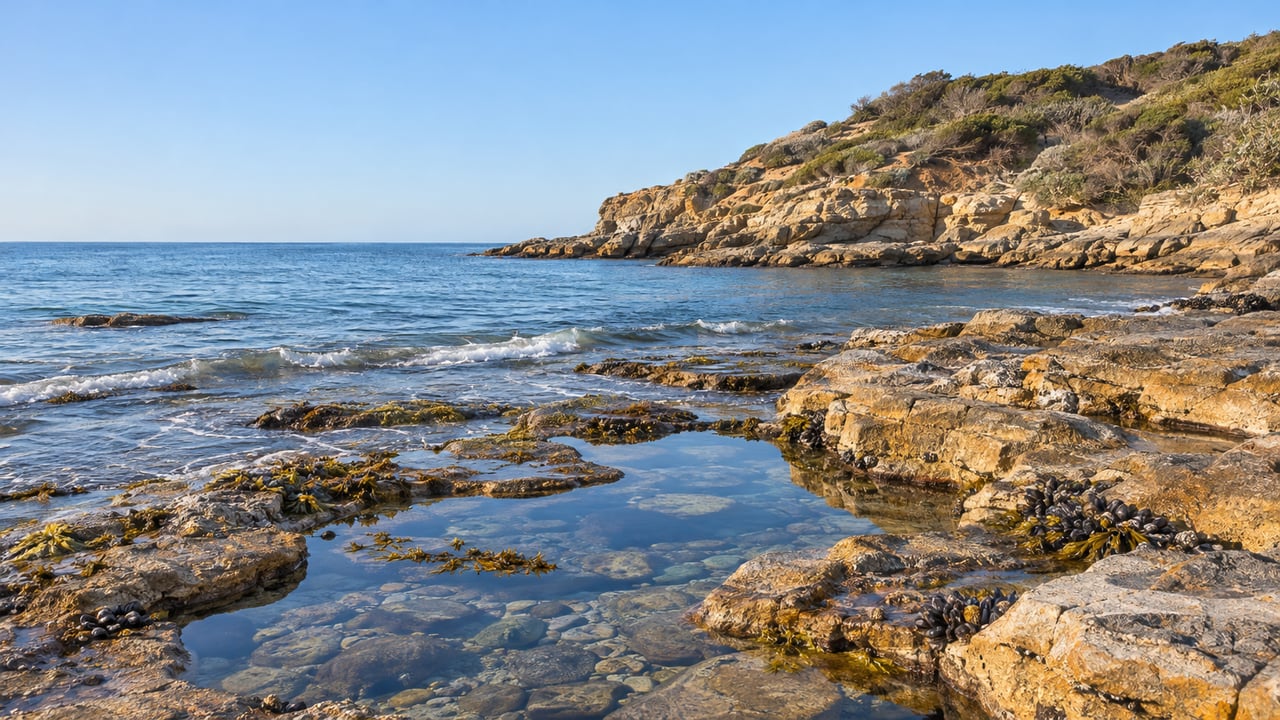
On Thanksgiving, the Pacific along Palos Verdes Estates drops to 1.36 feet below the zero line on NOAA's tide chart, but the bottom of that tide comes at 4:52 p.m. The evening before, sunset is at 4:45 p.m., according to timeanddate's table for Palos Verdes Estates. By the time the rocks below the bluffs are fully exposed on Thanksgiving, there is almost no light left to see them by.
The deepest low tides of the season do come in the afternoon this winter, but most of them are not on the dates people tend to circle. The best afternoons of Thanksgiving week fall on the Monday and Tuesday before the holiday. The lows in Christmas week and during January 19 to 22 drop further than Thanksgiving's, and they arrive early enough to leave daylight for the climb back up.
Thanksgiving week, two days early
NOAA's predictions for station 9410660, Los Angeles Outer Harbor, are the nearest reference for the Palos Verdes Estates shoreline. They show next week's series of minus tides sliding later into the afternoon each day. The series starts gently on Sunday, November 22, with a minus 0.50-foot low at 1:43 p.m. Monday, November 23, reaches minus 1.05 feet at 2:26 p.m., and Tuesday, November 24, reaches minus 1.38 feet at 3:11 p.m. Wednesday, November 25, goes deepest at minus 1.47 feet, but not until 4:00 p.m., 45 minutes before sunset. After Thanksgiving's after-dark low, Friday's comes at 5:48 p.m. at minus 1.08 feet, Saturday's at 6:47 p.m. at minus 0.70 feet, and Sunday's 7:47 p.m. low barely dips below zero.
The same drift runs through each series of minus tides in the NOAA tables this winter. The lows start near midday and come later each afternoon, by roughly half an hour to an hour a day, so the early days of a series are the ones with time to look around.
The December and January afternoons
All of the times and depths below come from NOAA's published predictions for the Los Angeles Outer Harbor station, in feet relative to mean lower low water and in local time.
- December 6 to 9. This is a gentle series, with lows between minus 0.47 and minus 0.66 feet that fall from 2:08 p.m. to 3:51 p.m. Monday, December 7, has a minus 0.63 foot low at 2:43 p.m., which gives the most light of the series for a modest tide.
- December 21 to 25. This is the deepest series of the calendar year. The tide reaches minus 0.96 feet at 1:37 p.m. on the 21st, minus 1.50 feet at 2:21 p.m. on the 22nd and minus 1.81 feet at 3:07 p.m. on the 23rd. Christmas Eve bottoms out at minus 1.87 feet at 3:52 p.m., and Christmas Day at minus 1.71 feet at 4:38 p.m. Sunset at the end of December is just before 5:00 p.m., with timeanddate putting it at 4:55 p.m. on December 31. December 23 is the best balance of depth and daylight in the series.
- January 19 to 22. This series has the deepest daytime tides of the season. January 20 reaches minus 1.70 feet at 2:12 p.m., and Thursday, January 21, reaches minus 1.92 feet at 2:53 p.m. Friday, January 22, comes in almost as low at minus 1.90 feet at 3:32 p.m. Sunset moves later through the month and reaches 5:23 p.m. by January 31. That leaves roughly two hours after these lows to explore and get back up the bluff in daylight.
A smaller series also falls on January 4 to 8, with lows near minus 0.7 feet between 2:03 p.m. and 4:04 p.m. It is a good option for anyone whose holidays keep them away from the coast in late December.
Those depths only help on a stretch of shore that can be reached on foot, and the City's coastline has few official ways down.
Malaga Cove, past a 1930 bathhouse
Palos Verdes Estates has had a written plan for keeping its shoreline natural since 1970. A City staff report from July 2016 traces the policy to the Shoreline Preserve Master Plan the City drew up in March 1970. It also notes that the Local Coastal Program, certified in 1991, designates the City's entire 4½-mile shoreline and about half of its bluff as open space. The same report names the two best access paths: Swim Club Road down to RAT Beach, and Flat Rock Point Path down to Bluff Cove.
At the north end, the California Beaches guide to Malaga Cove starts the walk at the public lot at Paseo del Mar and Via Arroyo and follows the Malaga Cove Trail down the bluff. At the bottom, a right turn leads to the sand of RAT Beach. A left turn leads past the athletic club to the rocky shore, the tide pools and the surf break known as Haggerty's. On a minus tide, turn left.
The City's history of the Palos Verdes Beach and Athletic Club records that the Bathhouse and Beach Club opened at Malaga Cove in June 1930 to a design by Kirtland Cutter. The City took ownership in 1939, and the club reopened under its current name in July 1993, with a six-lane competition pool and a children's pool.
Parking near the plaza may get some attention in the coming months. At its October 13, 2026 meeting, the City Council heard an overview of a Malaga Cove Plaza parking study by Cal Poly Pomona's Department of Urban and Regional Planning. The study involves 22 senior students and is expected to be finished in May 2027, so student fieldwork around the plaza is part of this winter. Paid parking along the blufftops came up only as a possible subject for a future study, according to the meeting minutes.
Bluff Cove, on land the City returned to open space
Further south along Paseo del Mar, Bluff Cove has a newer kind of history. The 2016 staff report records that in 2015 the City demolished seven private residences in Bluff Cove to create open space and return the land to public use and access. The Council later approved "sitting rocks" on those parcels. The blufftop above the cove used to be private homes and is now public open space.
The California Beaches guide to Bluff Cove describes shoulder parking on Paseo del Mar between Via Almar and Palos Verdes Drive West. From there, a trail descends the bluff to the cove, and a steeper branch drops to Flat Rock Point. The guide notes that at low tide the shoreline is walkable in both directions, and that the shore to the south is part of the Palos Verdes Estates Shoreline Preserve. It also calls the cove rocky and recommends proper footwear. The guide dates from 2021, so check the signs and the condition of the trail at the top before starting down.
Lunada Bay is best seen from the bluff
The 2016 report says Lunada Bay has an access path the City authorized in 1972, used less than the others because of how steep it is. The same report also quotes the California Coastal Trail website's description of the spot: a scenic blufftop trail, "no safe beach access," free public parking and no facilities. The same passage notes that official access routes exist only at Malaga Cove and Bluff Cove. That makes Lunada Bay the place to watch a minus tide from the top of the bluff. The City's recreation page describes the blufftop trails that run from the 1300 block of Paseo del Mar south to the city line.
What lives under the rocks
The Palos Verdes–South Bay chapter of the Sierra Club has documented what lives in the peninsula's tide pools in a natural-history piece on local tidepools. It lists ochre sea stars, bat stars, purple sea urchins, sea anemones, sea hares that graze on algae, and a spotted octopus. The chapter notes that octopuses tend to hide under rocks. It also points out that every animal exposed by the tide is already under stress from drying out and from the change in temperature, so an overturned rock should go back the way it was found.
The City's 1970 plan set the goal of keeping this shoreline "in its natural state as nearly as possible," and the City reports that signs along the entire shoreline mark the Palos Verdes Estates Shoreline Preserve. Further south in Rancho Palos Verdes, the California Department of Fish and Wildlife manages the Point Vicente and Abalone Cove State Marine Conservation Areas, the nearest state marine protected areas on the peninsula.
For a single afternoon this winter, choose December 23, January 21 or January 22. On each of those days the tide drops below minus 1.8 feet with time left to explore before sunset.
An architect's eye lingers on Kirtland Cutter's 1930 bathhouse at Malaga Cove, and Astoria Luxury Estates has the same appreciation for the blufftop blocks along Paseo del Mar. If you live in Palos Verdes Estates and would like to talk about the homes along this shoreline, Reach Out Today.